
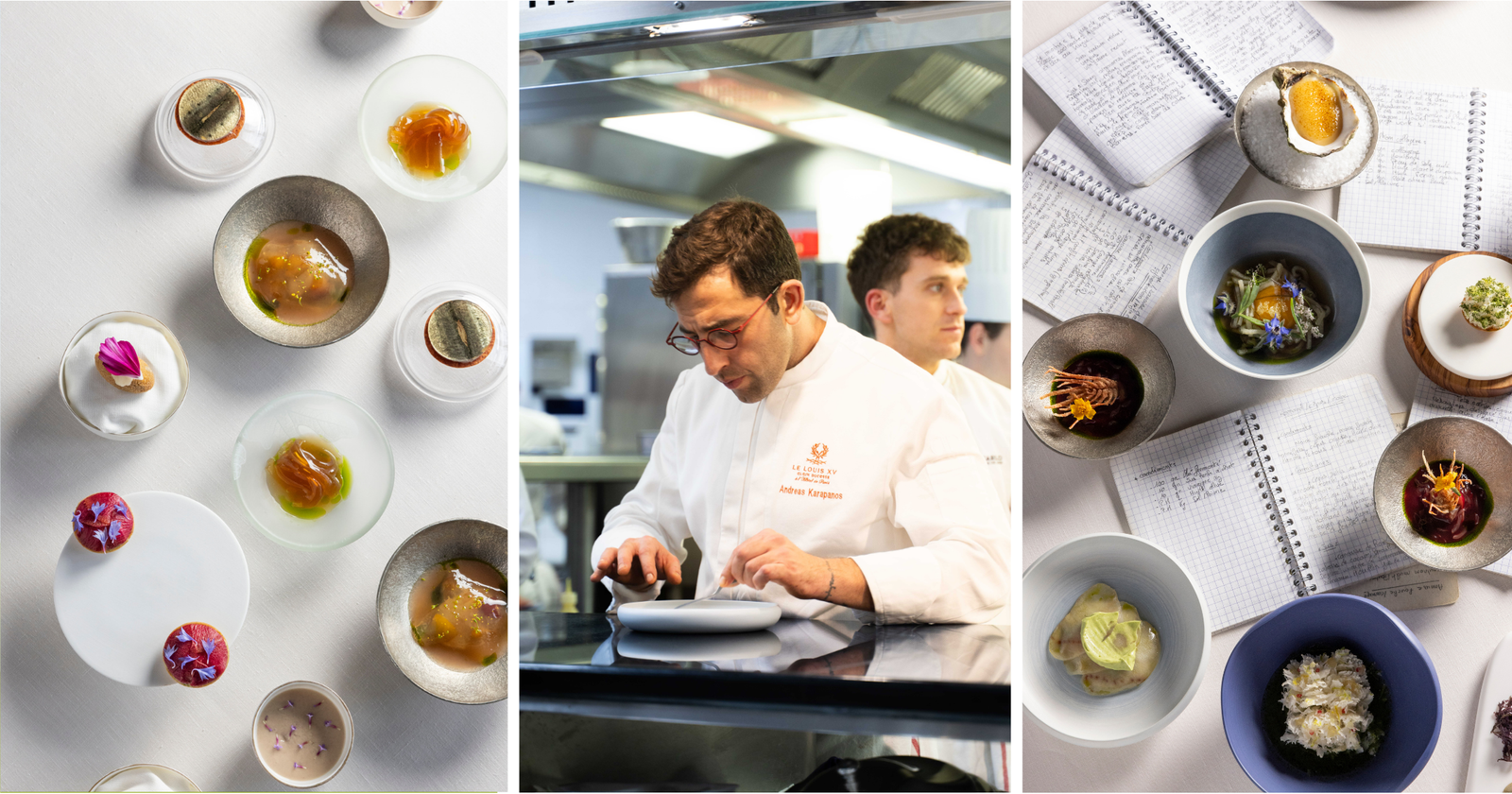
Every Tuesday morning, Andreas Karapanos drives from Monaco to the market in Ventimiglia, Italy. The vendors know him by now—the Greek chef who arrives early, who examines their produce carefully, who asks what they have that day. He moves between their stalls slowly, selecting fruits, vegetables, herbs, whatever the season offers. By evening, it will all be on plates at Le Louis XV-Alain Ducasse at Hôtel de Paris Monte-Carlo, where he works as chef adjoint.
The restaurant has held three Michelin stars for 35 consecutive years. When Ducasse evolved the menu into an even more plant-forward concept, it marked a new chapter. “We’re building something different now,” Karapanos said. And people are responding to it.
For Karapanos, the 34-year-old Greek chef who arrived three years ago to execute this transformation, the evolution was the point. He is not primarily working with fish or meat anymore; he is mostly focusing on what he is sourcing. In a dining room with a storied Mediterranean tradition, he now builds entire dishes around zucchini, around the particular sweetness of a carrot pulled from specific soil.
He bypasses traditional suppliers almost entirely. He visits a private farmers’ collective in a mountain cabin in Italy—they tell him to help himself, to collect eggs directly from the chickens. He returns with produce still carrying morning dew, eggs tucked carefully in his bag.
What he finds shapes his obsessions. “My secret ingredient changes according to the season,” he said. “Right now, I’m crazy about artemisia, a bitter herb. I found a bunch at the market; nobody was paying attention to it. I make artemisia oil for the restaurant.” But his all-time favorite not-so-secret obsession has always been olive oil.
Le Louis XV-Alain Ducasse has always championed Mediterranean cuisine with vegetables and olive oil at its foundation. Under Ducasse’s vision, the restaurant has continued to deepen this commitment, moving even further toward a plant-forward approach. Karapanos and executive chef Emmanuel Pilon built a new team around this evolved vision.
When Karapanos and Pilon spoke with Ducasse about the transformation, they discussed integrating his Mediterranean identity into the cooking. “I’m not cooking Greek cuisine,” he said. “But it has influences.”
The restaurant makes patsas, traditional Greek tripe soup. He’s working on a dish of small local fish: sea bream, red mullet, and mackerel, combined with quince that has become a signature, included in Ducasse’s cookbook. The approach draws on Greek culinary instincts without literally reproducing Greek dishes.
The journey that led him here, though, was never part of any plan.
Growing up in Patras, Greece, Karapanos wanted to become a physicist. He had no culinary background. Then came mandatory military service in Sparta. On his first day, he was assigned to the kitchen.
“I saw 17 cooks in that kitchen, most of whom had finished culinary school,” he recalled. “And I started to develop this great admiration for the fact that a 20-year-old had already decided to become a chef. It seemed dreamlike to me.” The certainty of it. He’d never seen anything like that clarity of purpose.
Just before discharge, he told his parents he was switching careers. They thought it was a phase. He enrolled at a culinary institute in Athens, landed his first job washing dishes, and then spent the summer in a restaurant in Mykonos. A chef there invited him to London. He was 22, spoke no English or French. “At that time I didn’t even know what currency the U.K. used,” he said.
But Karapanos had discovered something in himself: an absolute, uncompromising drive for cooking. He ended up at the Mandarin Oriental in London, but even there, he knew it wasn’t enough. He needed Paris. He needed to be at the center of it all. He set his sights on L’Atelier de Joël Robuchon Étoile, the restaurant of the chef with the most Michelin stars in the world.
He sent his CV. And sent it again. And again. “Seventy-seven times,” he said. The number is exact. He started there in August of 2016. L’Atelier de Joël Robuchon Étoile made Karapanos the chef he is today. “That’s where I built character,” he said.
But Karapanos knew that if he wanted to advance in French kitchens, he needed to speak the language. He learned French to professional fluency in 18 months while working 19-hour days; the kind of days where you forget what sunlight looks like.
He left as junior sous chef. The executive chef at Shangri-La Paris recruited him. Then came Alain Ducasse au Plaza Athénée, Ducasse’s Parisian flagship.
It was at Alain Ducasse au Plaza Athénée, working under chef Romain Meder, that Karapanos first understood what creativity could mean in a kitchen of this caliber. Meder had tried kourabiedes, traditional Greek almond cookies dusted with powdered sugar, on a trip to Greece and challenged Karapanos to reimagine them for the restaurant. “I was surprised he wanted me to use a Greek dessert on his menu,” he said.
Karapanos made them with chestnuts instead of almonds and grilled them over charcoal instead of baking them. The smoke changed everything. Alain Ducasse au Plaza Athénée began serving them as an amuse-bouche. “That was the first time I truly understood the meaning of creativity,” he said. “To take something from your culture and adapt it to the proportions that suit you and the restaurant where you work.”
That lesson became the foundation for his work in Monaco. He operates with a precision that borders on obsession. When Pilon tells him they need to carry over certain dishes from one menu to the next, he begins with flavor combinations and envisions the taste first, the way it should land on the palate, then builds backward to technique and presentation.
“I don’t sleep at night,” he said. “I am constantly thinking.”
A few days ago, he pulled a carrot from the refrigerator, set it on the cutting board, and stood there. Just thinking. What could he make with it? How should he cut it? What would bring out its sweetness?
At Le Louis XV-Alain Ducasse, because he works almost exclusively with produce, he has developed an obsessive attention to how it is cut and presented, how the knife angle changes the way something tastes.
But this level of focus only works with the right partner. Pilon, as executive chef, leads the overall vision. “He’s the one who orchestrates the dishes, the flavors,” Karapanos said. “And he happens to like what I do.”
Karapanos is the only Greek to ever work at this level in a Ducasse kitchen. He knows the privilege of this position, its weight, and improbability. He knows the cost, too. He has earned it all.
Every day, Karapanos buttons up his chef whites, the uniform that took a decade to attain, his name embroidered on the left side beneath the restaurant’s logo. He walks into a kitchen that has held three Michelin stars for 35 consecutive years. He has spent his career learning what great cooking requires: passion, precision, sacrifice, and obsession.
At Le Louis XV-Alain Ducasse, Karapanos has discovered what great cooking allows: the freedom to evolve tradition.
Images: Le Louis XV-Alain Ducasse